Rockland has a plain warning for residents: wipes labeled flushable clog sewer pipes, damage pumps and can cause raw sewage overflows into homes and businesses. A backup is one of the hardest water problems to live with, and it is worth knowing how it starts and what the cleanup involves.
Key takeaways
- The town warns that wipes labeled flushable clog sewer pipes and damage pumps, and can cause raw sewage overflows into homes, businesses and local waterways.
- Most properties in Rockland are connected to town sewer, so a clog or overload can show up in a house drain.
- A sewage backup is Category 3 water, so porous materials that touched it are removed and the area is cleaned and treated.
- The household should stay out of the area, avoid using water and wait for trained crews before cleanup.
- Only toilet paper belongs in a toilet; wipes, even those labeled flushable, go in the trash.
What the town says about wipes
The Rockland Sewer Department is overseen by a Sewer Commission, and most properties in town are connected to the town sewer. That means a clog or overload in the system can show up as a backup in a house.
The town warns that wipes labeled flushable do not break down the way toilet paper does. They clog sewer pipes, damage pumps and can cause raw sewage overflows into homes, businesses and local waterways.
By law the Sewer Department must notify the public when a sanitary sewer overflow occurs, and those notices are posted on the town sewer page.
Where a backup shows up first
Sewage looks for the lowest opening it can find. In most houses that is a floor drain, a tub, a shower or the toilet on the lowest level.
A single slow drain is often a local clog. When several fixtures gurgle, back up or empty slowly at once, the clog is usually deeper in the pipe.
- Gurgling sounds from a toilet or drain when another fixture is used.
- Water or sewage rising in a floor drain or tub.
- A sewer smell in a room with no visible spill.
- Several fixtures draining slowly at the same time.
Why a backup is Category 3
Sewage carries bacteria, viruses and other contaminants. The IICRC S500 standard rates it as Category 3, the most contaminated category, no matter how clear the water looks.
That rating drives every decision on the job. Hard surfaces can be cleaned and treated, but porous materials that soaked up sewage are removed instead of dried.
- Carpet, pad and rugs: removed and discarded.
- Drywall, baseboard and insulation touched by sewage: cut out above the height sewage reached.
- Mattresses, cushions and stored paper: discarded.
- Tile, sealed concrete and metal: cleaned, treated and dried.
What the cleanup involves
Containment and removal
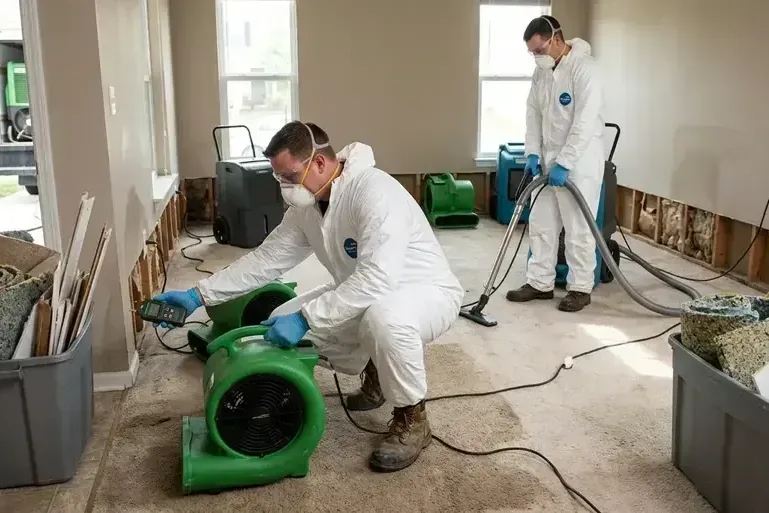
Crews in protective suits and respirators contain the area first, so contamination does not travel on shoes or air movement. Standing sewage is pumped out, and affected materials are bagged and carried out.
This is the stage covered by sewage backup cleanup.
Cleaning and drying
After removal, surfaces are washed and treated, and the rest of the room is dried. Air movers and dehumidifiers run until moisture readings match dry reference points.
The equipment and readings are described under structural drying.

After a backup: what not to do and how to stay safe
First reactions to avoid
The first reaction is often to mop it up. With sewage that is the wrong move, since it spreads contamination and puts the household in direct contact.
A few simple rules keep people safe until the cleanup crew takes over.
- Do not use sinks, tubs or toilets, because more water can add to the overflow.
- Do not walk through the area barefoot or let children and pets in.
- Do not mix cleaning products, since some combinations create harmful fumes.
- Do not run a household vacuum or fans on wet sewage.
Health precautions
Sewage is more than a mess. It can carry germs that spread through skin contact, splashes and contaminated surfaces.
Until the area is cleaned and treated, the household treats the room as off limits and keeps its habits simple.
- Wash hands with soap after any contact, even with gloves.
- Throw out food, drinks and cooking items that sat in or near the water.
- Keep pets out of the room and away from the drain.
- Wear rubber boots and gloves for any brief entry, and remove them outside the room.
- Tell the insurer early, since sewer backup coverage is often a separate part of a policy.
Water use while the pipe is blocked
A washer, dishwasher, shower and sink can all drain into the same pipe as the toilet. Using them while the pipe is blocked can add to the overflow.
A short pause on water use is the simplest way to keep the spill from growing.
- Hold off on laundry and the dishwasher until the pipe is cleared.
- Use another bathroom if the house has one on a different level.
- Take short breaks from showers and sink use, and keep a bucket for emergencies.
- Ask the plumber to confirm the pipe is flowing before normal use resumes.
Habits that keep pipes clear
Prevention starts with what goes down the toilet. Toilet paper breaks down quickly in water, and nearly everything else does not.
Grease and cooking oil harden in pipes, and food scraps add to the buildup. A plumber can inspect the house drain with a camera if backups keep returning.
- Put wipes in the trash, even those labeled flushable.
- Throw out cotton swabs, dental floss, paper towels and hygiene products.
- Pour cooking grease into a container, not the sink.
- Report repeated slow drains early, before a full backup.
House pipe or town sewer
When a backup happens, a plumber can check the house drain and the pipe leading out of the building. If the problem may be in the street, the Rockland Sewer Department is the office to tell.
Whichever side the clog sits on, the room that backed up needs the same cleanup.
The main sewage backup cleanup service page lays out the same steps, and the Rockland water damage pages cover the other kinds of loss a house can face.